The “Offsite Illusion” and the Strategy-Reality Gap
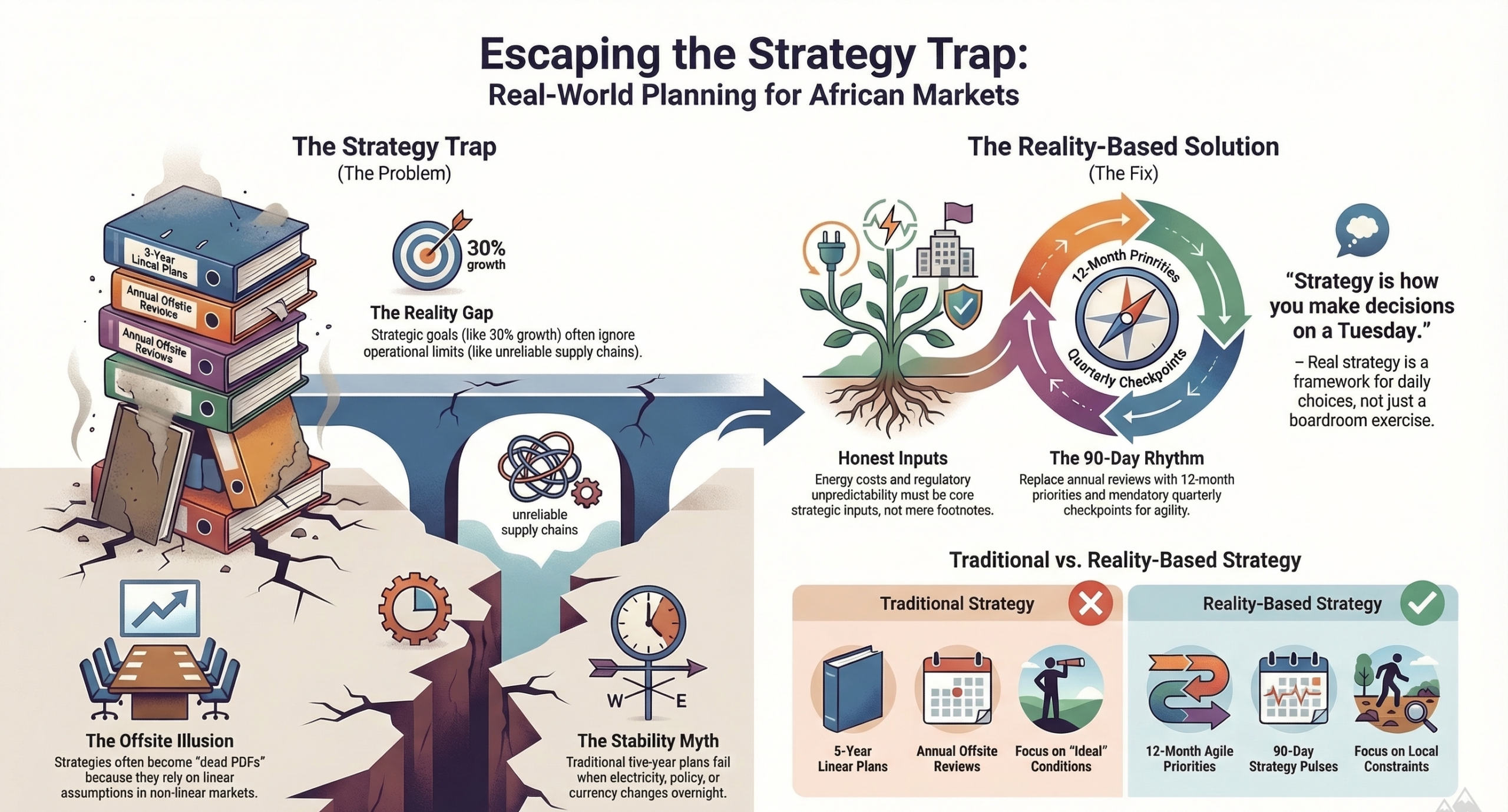
You know the scene. You’ve flown the leadership team to a high-end retreat. You’ve spent three days in a climate-controlled boardroom, smelling expensive coffee and debating SWOT matrices on colorful Post-it notes. Everyone nods at the polished PowerPoint slides. You leave feeling energized, clutching a thick PDF that promises a bold new future.
Then Monday happens.
Back in the office, that document isn’t running the business. It’s gathering dust in a digital folder while your margins evaporate in real-time. Instead of strategic execution, your company is managed through frantic WhatsApp threads, gut-instinct calls, and whoever happens to be shouting the loudest in the hallway. This is the Strategy Trap.

Traditional, linear frameworks are designed for stable, predictable environments. African business strategy requires a different approach because our markets are neither stable nor predictable. When a single government announcement can rewrite your operating conditions or an overnight currency devaluation wipes out your procurement budget, a five-year plan built on rigid assumptions isn’t just a document—it’s a hallucination. This isn’t a failure of discipline; it’s a failure of design.
- Takeaway 1: Prediction is Fiction—Agility is Fact
In the African corporate landscape, stability is a myth. External variables—ranging from sudden diesel price hikes and grid collapses to surprise tax levies—invalidate long-term linear planning within weeks, if not days.
To survive, we must stop pretending that planning means “prediction.” In Lagos, Nairobi, or Johannesburg, trying to guess the market state in 2029 is a waste of ink. We must redefine planning as preparation. It is about building an agile framework that allows your business to respond to reality as it unfolds. You don’t need a static map; you need a high-functioning compass and the strategic muscle to pivot before the competition even realizes the ground has shifted.
- Takeaway 2: The “Tuesday” Test—Strategy as a Decision Framework
The true measure of your strategy is not its aesthetic appeal. The real test happens on a mundane Tuesday: does your strategy actually guide the decisions being made on the shop floor or in the warehouse?
When strategy stays at a level of abstraction that doesn’t connect to daily operations, you aren’t just losing alignment; you’re burning capital.
Signs Your Strategy has a Reality Gap
- The Logistical Lie: Your strategy calls for expanding to Kano when you can’t even get product to Ikeja reliably.
- The Growth Paradox: You’ve set a 30% revenue growth target, but your operations team is currently bleeding customers to three new competitors who popped up this quarter.
- The Internal Conflict: Your strategy focuses on “customer-centricity,” but your finance team just changed the pricing model without telling the sales team, killing your frontline credibility.
“The best strategy is not the one with the most pages. It is the one that every person in your organization can explain in their own words and connect to what they did today.” — Olutope Olatilewa E. (Lady Topsie)
- Takeaway 3: The 90-Day Pulse
It’s time to stop lying to your board with “five-year visions” that no one believes in. In a market where conditions shift in a single quarter, an annual review is a death sentence.
Effective strategy requires a 90-day rhythm. This doesn’t mean you abandon your long-term ambitions; it means you break them into twelve-month priorities with mandatory quarterly checkpoints. If the price of raw materials doubles or a new regulation drops in month two, you don’t wait for next year’s retreat to react. You adjust your pulse. This shorter cycle ensures your business remains tethered to current market realities rather than stale assumptions made months ago.
- Takeaway 4: Run Your Ideas Through a “Reality Filter”
Stop treating strategic planning as a wish list. Every major objective must be dragged through a “Reality Filter” to see if it survives.
Ask your team: “What would have to be true in our specific market for this objective to be achievable?”
If your answer relies on conditions that don’t exist—for instance, if your strategy requires 99% uptime from the grid but you haven’t budgeted for a massive diesel hike—your strategy is a fantasy. Your inputs must explicitly account for:
- Energy costs: Real-world fuel prices and generator maintenance.
- Logistics gaps: The actual state of the roads and port congestion.
- Talent shortages: The “Japa” syndrome and the drain of skilled labor.
- Regulatory unpredictability: The high probability of overnight policy shifts.
Takeaway 5: Strategy is a Multi-Level Conversation
Strategy dies when it’s locked in the boardroom. For execution to move, the link between executive direction and unit-level action must be unbreakable.
Middle managers shouldn’t be guessing. They need a localised strategy for their specific units that connects directly to the top-level goal.
Example: If your 90-day pulse identifies a need to protect high-margin clients, your warehouse manager should know exactly how to prioritize their stock releases on a Tuesday morning to support that specific goal.
If a department head cannot explain how their weekly activities move the needle, your strategy hasn’t permeated the organisation—it’s just a memo.
Future-Proofing: AI and the New Strategic Muscle
By 2027, the landscape will be dominated by global trade realignments and the expansion of digital economies. AI-powered tools will allow savvy African businesses to run real-time scenario simulations against live market data, testing their resilience before they commit capital.
However, technology won’t save a broken culture. Companies building strategic muscle now—the internal capacity for agile, honest, and multi-level planning—will use these tools to dominate. Those who only focus on “better-looking documents” will find that AI simply helps them produce faster, more attractive fictions.
Strategic Insider Tip for Diaspora Investors: The real opportunity isn’t in the shiny multinationals. It is in the mid-size African companies that have built serious strategic capacity. These businesses understand the local grit; they just need capital to scale their agile frameworks. Look for the companies that have a “practice,” not just a “plan.”
Conclusion: Moving Beyond the Trap
Strategy is a practice, not an event. It is the framework that shapes how you make the hard calls every single day. If you continue to plan for the business you wish you had, you will continue to be blindsided by the realities of the business you actually run.
Ask yourself: If your 5-year plan was erased today, would your team still know how to make the right decision tomorrow morning?
Ready to move from The Strategy Trap to Strategic Planning action?
The BWB – The Strategic Planning Masterclass Series and Executive Coaching is a hands-on, in-depth, and highly interactive program designed specifically for business owners and executives committed to building with clarity and purpose.
Explore The Strategic Planning Masterclass Series or the Executive Coaching
#Africanbusinessstrategy, #strategicplanningAfrica, #businessstrategyAfrica,, #strategicplanningforAfricanbusinesses, #executivestrategyAfrica, #businessgrowthAfrica, #corporatestrategyNigeria, #strategyexecutionAfrica, #whystrategyfailsinAfricanbusinesses, #howtobuildabusinessstrategyinAfrica, #strategicplanningchallengesinNigeriaandAfrica, #practicalstrategyforAfricanexecutives, #businessstrategyforAfricanCEOs