The $5 Billion Discount: Why Your Competitors are Ignoring the AfCFTA—And Why You Shouldn’t.
Let me be candid with you from this very first paragraph. The majority of information that is out there on the African Continental Free Trade Area (AfCFTA) is written by economists and targeted at government officials. It has a of technical jargons, protocol designs, and implementation plans that leave CEOs of businesses and organisations in Lagos, Nairobi, and Kigali wondering and asking themselves the same frustrating question: “What does this really mean to my bottom line?”
Let me assure you that while the “policy version” of AfCFTA is about regional integration, the “business version” is about profit and market leadership. And given the current state of currency pressures and global trade wars, this is not a diplomatic nicety—it’s a strategic imperative. AfCFTA has gone from aspiration to architecture. It is happening, with or without your business.

Here are the five “business version” takeaways you need to master.
1. The “Disappointment” That Is Actually a Goldmine.
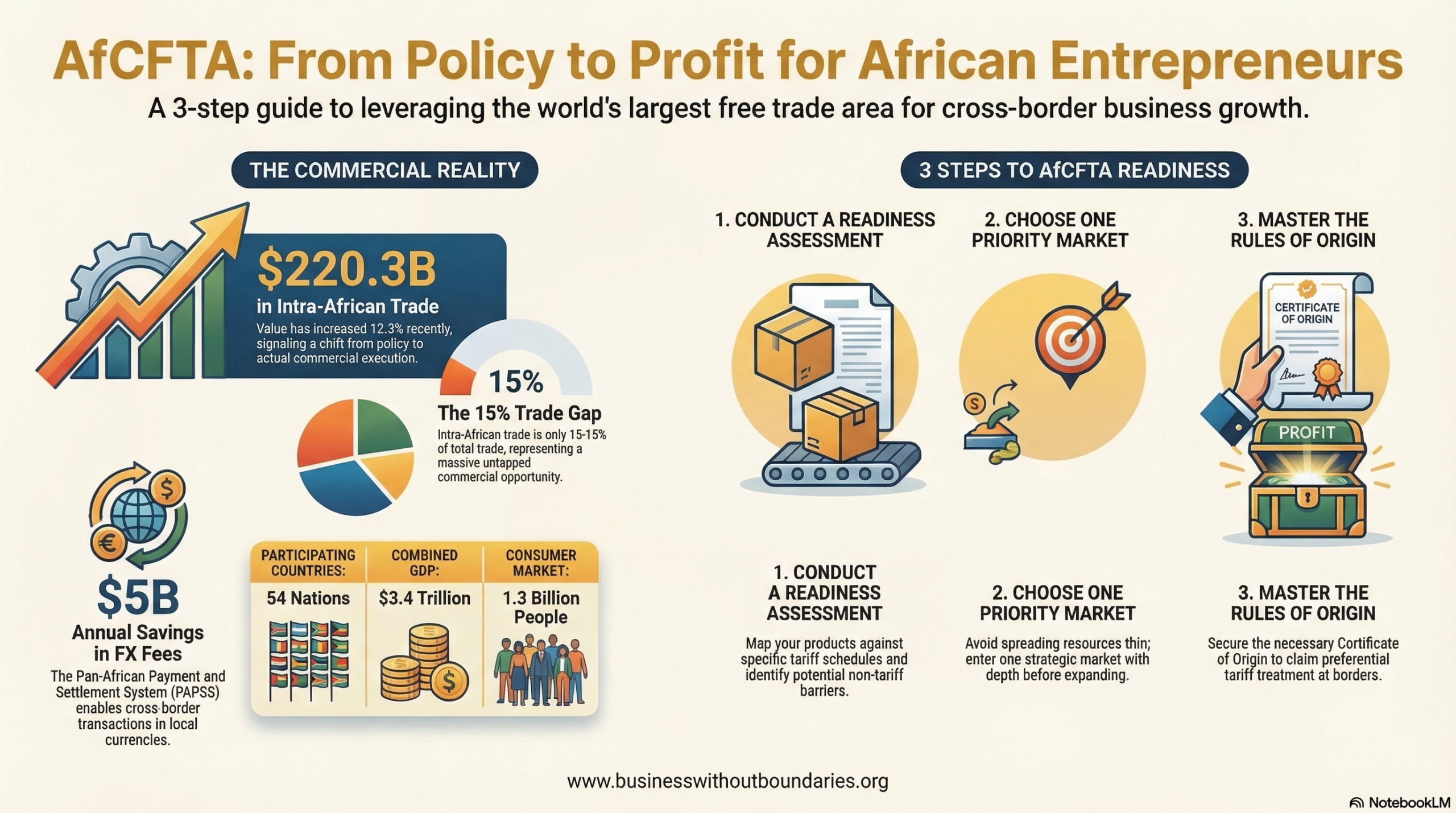
You will often be told that the level of trade within Africa itself is only 15% to 18%. This compares unfavourably with 68% for Europe or 59% for Asia.
But, as you can see, if you look at the volume of trade, the amount of trade within Africa itself is increasing, reaching $220.3 billion, which is up 12.4% over the previous year. And for the savvy business person, that difference between 18% and 68% isn’t a disappointment; it is the size of the commercial opportunity.
“That gap is not a disappointment. It is the size of the commercial opportunity.”
2. The Myth of the “Perfect Start”
No longer do business executives need to hold out for the “grand opening” ribbon-cutting ceremony. The Guided Trade Initiative (GTI) has been officially concluded in May 2025, with the announcement that Africa is officially ready! The “perfect start” has already been achieved, and most executives were still checking the calendar to see when it started.
The Guided Trade Initiative has demonstrated that trade is available right now in countries such as South Africa, Egypt, Rwanda, and Nigeria. We’re not discussing pilot projects anymore; we’re discussing actual shipments of tea, chemicals, and manufactured products.
The First-Mover Advantage in Action
Igire Coffee (Rwanda): This women-owned business did not hold out for 100% implementation; it shipped premium coffee to Ghana on preferential terms.
Exide Batteries (Kenya): It has secured its position in the market by shipping batteries to Ghana, thus demonstrating that the systems for industrial products are already live.
The companies that are succeeding right now are not holding out for the path to be cleared; they’re the ones clearing the path!
3. The $5 Billion “Hidden Discount” for SMEs
If you have ever tried to pay a supplier in a neighbouring African country, then you know the “invisible tax” of currency conversion. Being forced to change your local currency into US Dollars simply to pay a partner in the next country over has killed more deals than I can count.
The Pan-African Payment and Settlement System (PAPSS) has completely changed the equation. By connecting over 150 commercial banks, this system allows you to trade in local African currencies.
The Bottom Line:
- Massive Savings: This system is estimated to save African businesses $5 billion annually in foreign exchange conversion fees.
- Digital Scale: For cross-border e-commerce and digital services, this removes the single biggest barrier to entry, making regional trade affordable for SMEs for the first time in history.
- Digital Growth: Service exports in ICT and transport have already grown by 11% year-on-year.
- Regional Output: With services and goods combined, the World Bank projects a regional output increase of $211 billion by 2035.


4. It’s Not Just for Factories—The Service & Digital Edge
One of the most costly misconceptions I have come across is the assumption that the AfCFTA is only for large-scale manufacturing. However, the Service Liberalisation Agenda is progressing at an advanced pace in the identified 12 sectors, including Communication, Tourism, Financial Services, and Transport.
If you have a consulting firm, a tech company, or a professional services company, then the Service Edge is where the action is. And this is complemented by the Women in Trade Protocol that specifically includes provisions for women-owned businesses.
The Momentum:
- Digital Growth: Service exports in the ICT and transport sectors have already grown by 11% annually.
- Regional Output: In terms of output, with services and goods combined, the World Bank estimates an increase of $211 billion by the year 2035.
5. The Strategic Pivot in a Global Trade War
As tensions between the USA and China intensify, a “Plan B” is emerging for global trade. And Africa can be that “Plan B,” if it can get its head around the Rules of Origin.
This is essentially the DNA of your product, proving that it is indeed made in Africa. At the moment, 92.4% of these lines have agreed-upon rules. This is especially pertinent to the auto industry, which must have 40% African content to enjoy zero or reduced rates on auto parts as of February 2026.
Key Opportunities:
Value Chains: This agreement is locking regional value chains into green minerals, pharmaceuticals, and auto parts.
The Safety Net: Afreximbank has launched a $10 billion AfCFTA Adjustment Fund to finance competitiveness upgrades and pivots into these new standards.
Summary: From Awareness to Action
The five pillars that support the transition from policy to practice are:
- Market Potential: Viewing the trade gap as the continent’s biggest untapped goldmine.
- Execution: Acting now (post-May 2025 GTI conclusion), not waiting for perfection.
- Efficiency: Leveraging the PAPSS to reclaim your share of that $5 billion in currency wastage.
- Service Edge: Leveraging the 12 priority service sectors for non-manufacturing economic growth.
- Global Positioning: Leveraging the 40% content rules and the Adjustment Fund for the creation of the global supply chain alternative.
The architecture for the single African market is no longer a dream but rather a reality. Africa is no longer waiting for anyone to be ready.
Are you positioning your business for the opportunity to lead, or are you waiting for the signal that will only come after your competitors have taken the market?
Ready to go from AfCFTA awareness to AfCFTA action?
The BWB AfCFTA Business Readiness Training is the only retreat-integrated AfCFTA training that is exclusively designed for private sector business leaders, covering all eight modules from implementation reality to your 90-day cross-border action plan. Facilitated by Olutope Olatilewa (Lady Topsie).
Learn more about AfCFTA Business Readiness Training at businesswithoutboundaries.org/afcfta-business-readiness-training
About the Author
Olutope Olatilewa (Lady Topsie) is a global business strategist, AfCFTA trade advocate, and executive leadership facilitator with over two decades of experience in all 54 countries in Africa. She is the founder of Business Without Boundaries (BwB) – Africa’s leading AfCFTA business readiness training platform and African ChangeMakers Initiative (ACi)