Business without Boundaries (BwB)
Strategy Without Borders. Results Without Excuses.
Turn AfCFTA from Policy
into Profit.
The only AfCFTA program that takes you from understanding the agreement to executing a personalised 90-Days Trade Floor Plan — with Rules of Origin Mastery, AI tools, and a Certified Planner Badge you can take to investors.
This Program Is Built for You If…

Export-Ready Entrepreneurs & SMEs
- Nigerian SMEs ready or planning to export
- Agro-processors seeking new continental markets.
- Creative industries expanding beyond Nigeria
- Digitally-native startups targeting African consumers
Sector Specialists & Industry Leaders
- ICT and digital services businesses
- Pharmaceutical and healthcare companies
- Automotive components and manufacturing
- Critical minerals and green value chain businesses

Trade Support Professionals
- Trade-support consultants and advisors
- Chambers and trade-promotion bodies
- Trade finance officers and bankers
- Government and institutional teams
Women & Youth-Led Businesses
- Women entrepreneurs ready to use the Women in Trade Protocol
- Youth-led businesses qualifying for AfCFTA inclusion programmes
- Businesses targeting DFI and donor-funded AfCFTA support
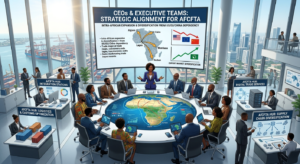
CEOs & Executive Teams
- Companies exploring intra-African expansion
- Leadership teams needing AfCFTA strategy alignment
- Businesses diversifying away from US/EU/China dependency
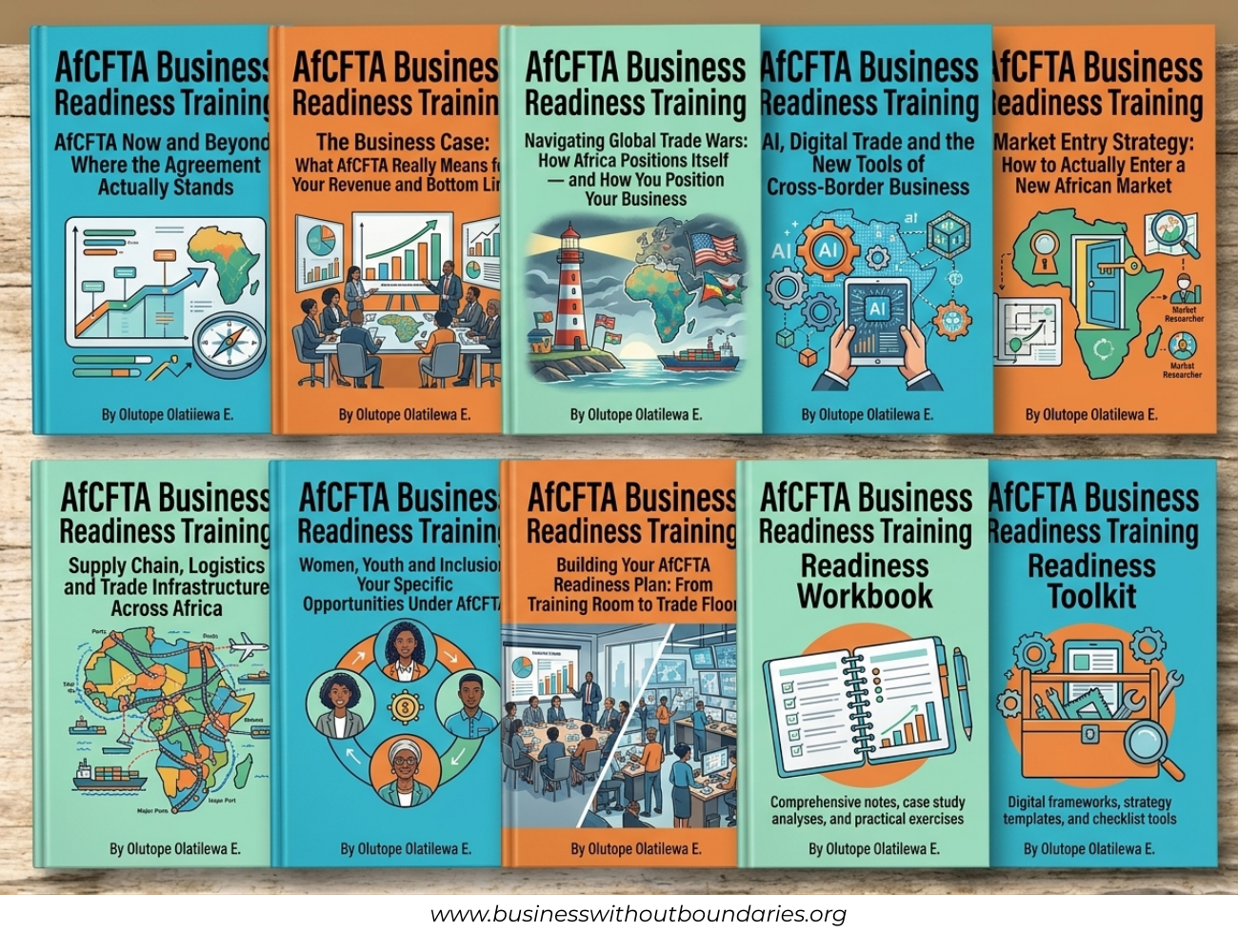
AfCFTA Now and Beyond + Rules of Origin Mastery & Certificate of Origin Strategies. Updated
Many people believe they have a grasp on what AfCFTA entails. However, only a small number understand what its current implementation actually looks like in practice — not in the press release, but on the ground.
This module gives you the clearest, most up-to-date view of the agreement as it stands today. Nearly 50 of 55 AU member states have ratified. Rules of origin are 92.4% finalised. Tariff concessions are gazetted in key countries including Nigeria. The Guided Trade Initiative is live, and intra-African trade has already surpassed $220 billion. You will understand exactly what that means for your business right now.

In this part, you will explore Rules of Origin Mastery, which is a key topic of AfCFTA that many people find confusing. You will figure out how to make sure your products can trade without tariffs, how to properly create and give out Certificates of Origin, and how to steer clear of mistakes that can cost your business money and reputation.
- Evaluate the current state of AfCFTA implementation in the markets that matter most for your business
- Determine which sectors are most affected and which are still under negotiation
- Assess your business readiness and identify which of your products qualify for zero tariffs under the Rules of Origin
- Prepare and submit your first Certificate of Origin correctly
- Navigate the step-by-step process for informal traders transitioning into the formal AfCFTA framework
The Business Case — What AfCFTA Really Means for Your Revenue and Bottom Line Updated
Even though numbers are very important in AfCFTA, they only make sense when you relate them to your business situation. A market with 1.5 billion people is only useful if you understand which part belongs to you, how big that part really is, and what it will cost to reach and serve those people.
This module changes AfCFTA from a big economic agreement into a practical Business Case for your company. You will pinpoint what role your industry plays in the new opportunities available, accurately size your target market across open African borders, and create a business case for your expansion into other countries that you can show to investors, management, and lenders.
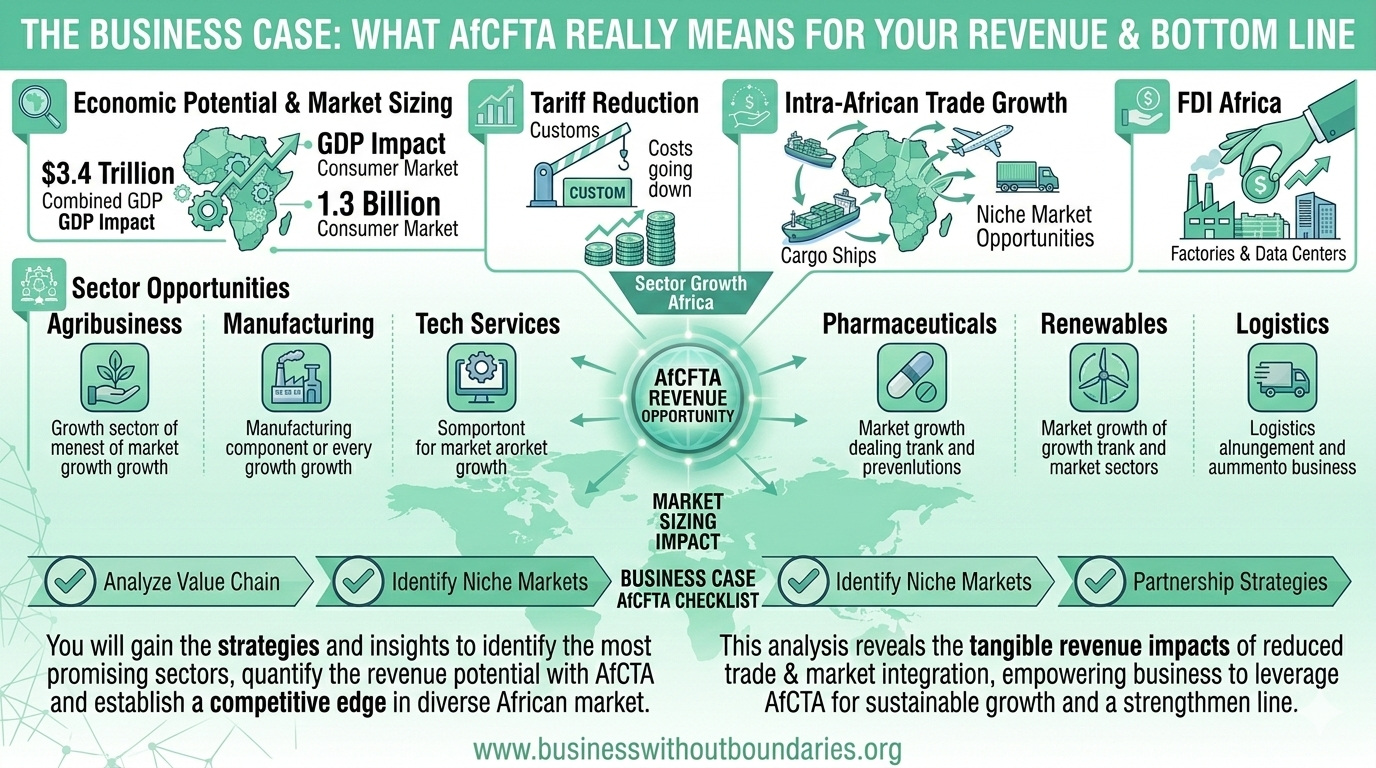
Special tracks focus on specific sectors like agro-processing, medicine, car parts, creating value from important minerals, and digital services. These sectors are experiencing the most growth in trade within Africa and align best with what the AfCFTA Secretariat wants to achieve by 2026.
- Identify your industry’s specific role within AfCFTA opportunities
- Size the potential of your target market across Africa’s liberalised borders
- Identify which markets present the most promising short-term prospects for your business model
- Build a robust business case for cross-border expansion you can present to investors and lenders
- Map your sector value chain and identify where value-addition creates the highest return
Navigating Global Trade Wars — How Africa Positions Itself and How You Position Your Business Updated
This modulen talks about the world situation in 2026 and beyond. Things like political divisions, the ending of the African Growth and Opportunity Act, the ongoing trade conflict between the United States and China, the race for important minerals, rising prices, and changing immigration rules are not just background details, but are the reality we have to deal with.
The African Continental Free Trade Area is becoming a key part of Africa's response to these challenges. In this module, you will discover how trade issues are opening up new chances for investment, manufacturing, and supply chains all over Africa. You will learn to create strategies that focus on Africa first, reducing dependence on outside countries, and instead building on Africa's own strengths. You will also find out how to adapt your business to take advantage of these changes.
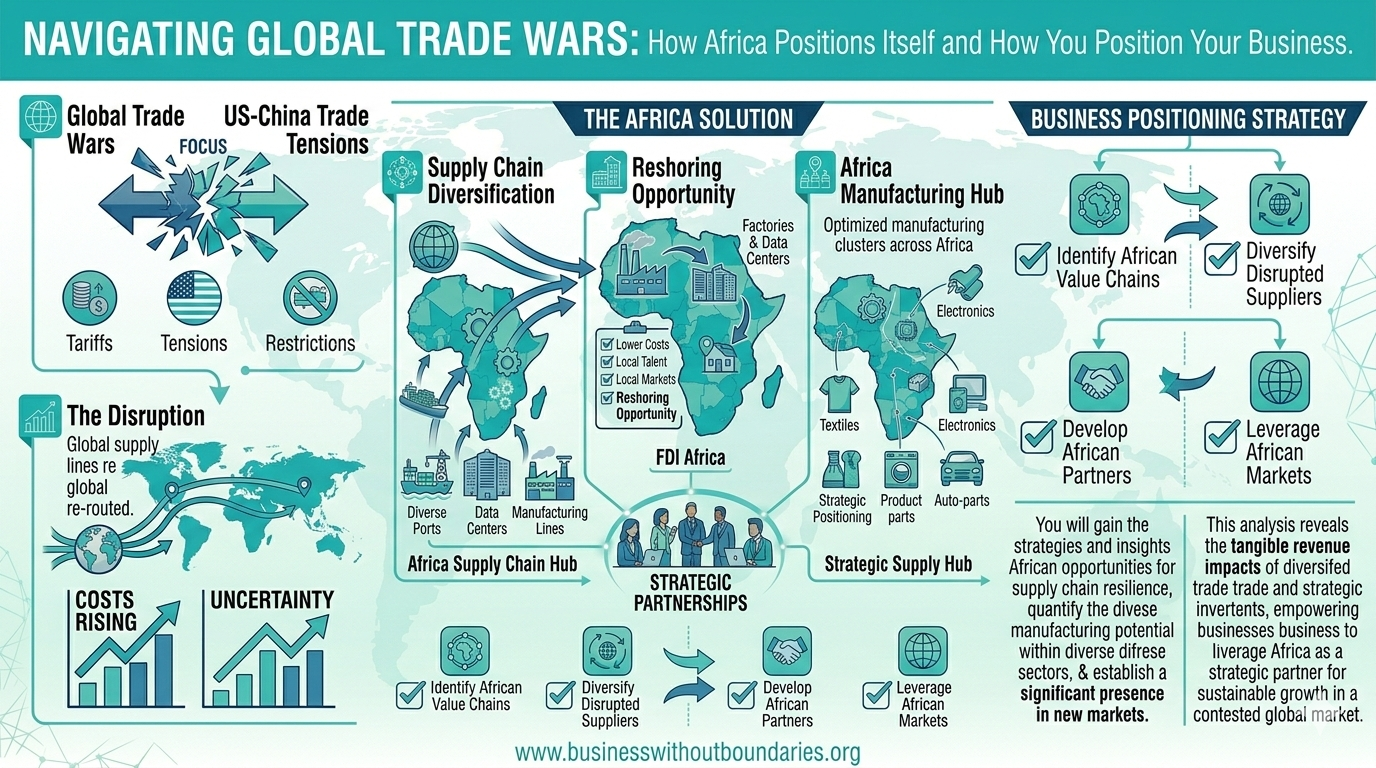
Additionally, you will create a plan for managing Geopolitical Risks and ensuring Supply Chain Resilience that is tailored to your business. This will include preparing for potential surprises like currency fluctuations, transport issues, and changes in policies that are now common in today's environment.
- Understand how current trade conflicts are generating real opportunities for African businesses right now
- Identify which industries and trade routes are experiencing the most benefit from global disruption
- Build a continental-first diversification strategy that reduces dependence on US, EU, and China markets
- Develop scenario plans for currency shocks, supply chain disruptions, and policy changes
- Position your business as a strategic winner in the current geopolitical landscape
AI, Digital Trade and the New Tools of Cross-Border Business New Content
The AfCFTA Digital Trade Protocol is probably the most crucial yet least understood part of the whole agreement. By 2026, having AI and good digital systems won't just be nice to have; they will be essential tools that will decide which businesses can take advantage of the AfCFTA's huge market worth $3.4 trillion and which cannot.
This module talks about the useful AI tools that are already making international trade easier for African companies. These include AI tools for analysing markets, checking Rules of Origin automatically, marketing across borders, predicting demand, and assessing if they are ready to export. You'll also learn about PAPSS, which stands for the Pan-African Payment and Settlement System, and how to use regulated stablecoins and local currencies for transaction.
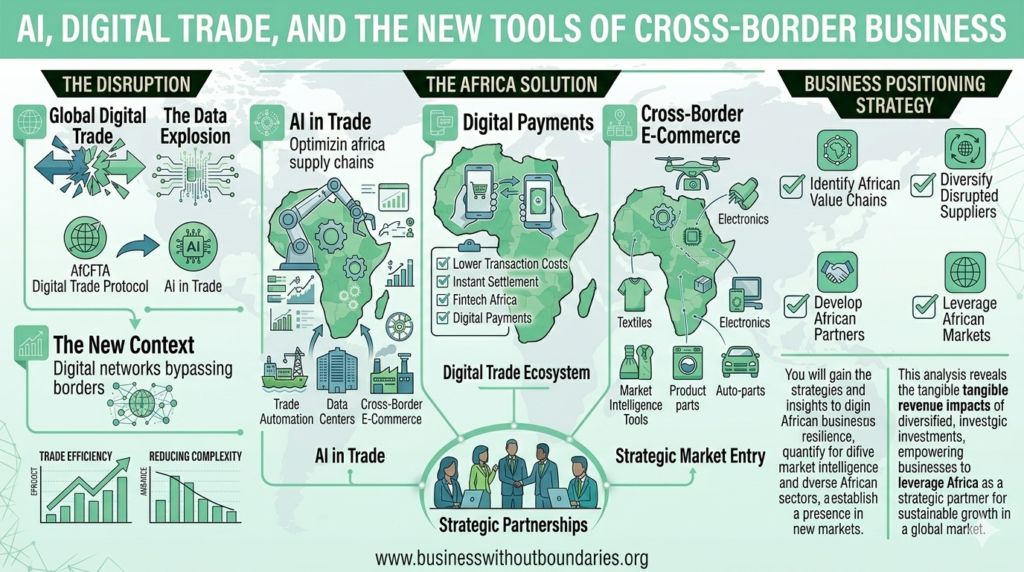
This is one of the biggest advantages available to small and medium-sized businesses in Africa right now. Most competitors are still using outdated methods to teach strategy. This section will give you a head start and put you ahead of the game.
- Apply AI tools for AfCFTA market scanning, export pricing models, and readiness risk analysis
- Understand and use the AfCFTA Digital Trade Protocol for your specific business model
- Use PAPSS and local currency settlement to reduce transaction costs on intra-African trade
- Implement digital compliance hygiene: invoicing standards, data privacy, e-platform onboarding
- Access and use the BWB AI Market Intelligence Toolkit — included free with this module
Market Entry Strategy — How to Actually Enter a New African Market
This is the most hands-on part of the whole series. The idea of choosing a market is pretty simple. However, many businesses have trouble with the actual process; they can feel confused by complicated rules, unclear about what they need to do to follow the law, and unsure about how to make their first steps without losing money fast.
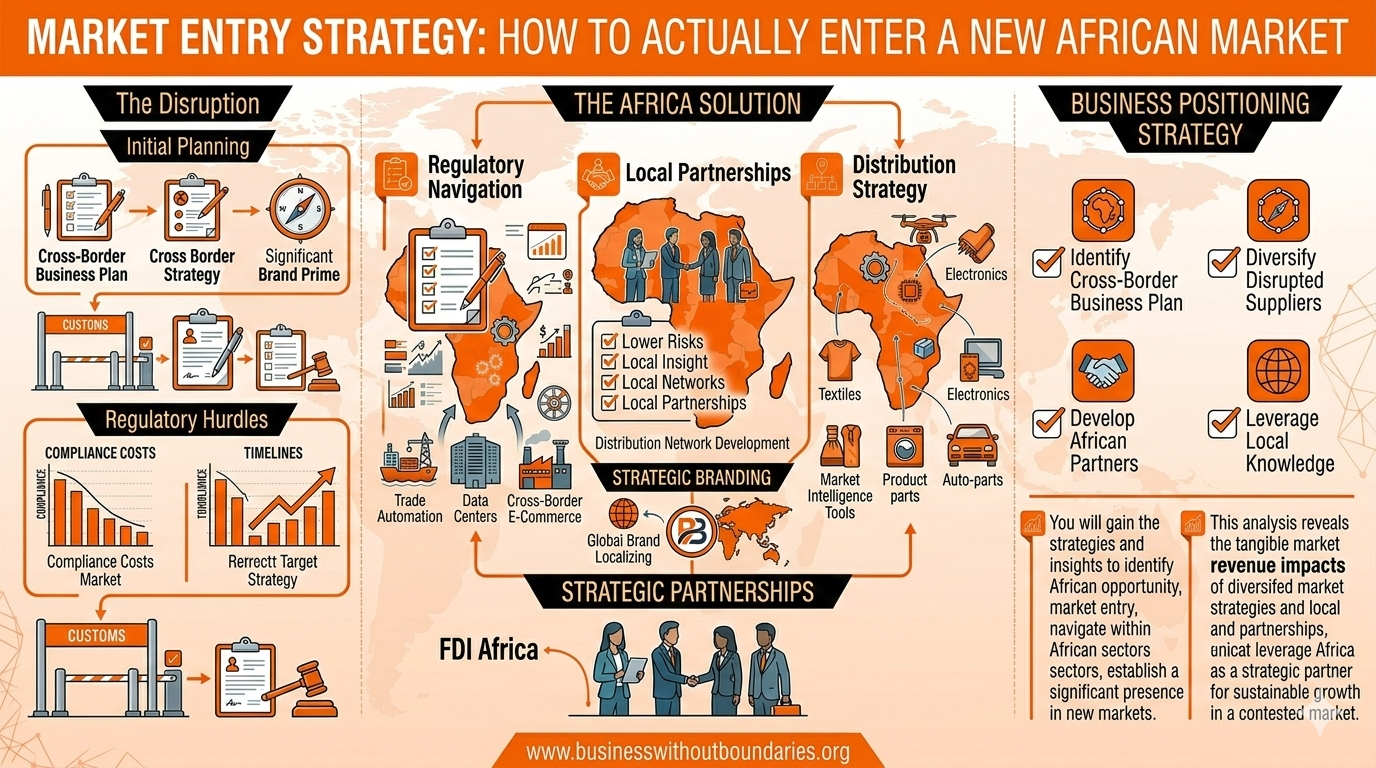
You will go through a detailed system to evaluate and choose your target market in AfCFTA carefully. You will learn about the rules and regulations in that market, create a strategy for how to enter the market to gain an advantage by being the first, and include the qualification for Rules of Origin in your revenue plan — so when you enter the market, you can do so without paying extra tariffs.
- Score and select your best AfCFTA target market using a structured assessment framework
- Understand the regulatory, cultural, and competitive landscape in your chosen market
- Build an actionable market entry plan that qualifies for tariff-free trade under Rules of Origin
- Map the fastest route to first-mover advantage in your sector
- Identify 1–2 export pilot countries to test within your first 90 days
Supply Chain, Logistics and Trade Infrastructure — Including Green Value Chains Updated
The main issue making trade between African countries difficult has always been logistics. Things like bad roads, trade rules that don't involve taxes, delays at customs, and confusing payment methods have stopped businesses with great products that meet AfCFTA requirements. This module gives you the tools and plans to deal with these challenges.
You will find the best and most affordable trade routes for your industry, create a supply chain plan that works well with Africa’s current infrastructure, and learn how customs rules are improving under AfCFTA, which is speeding up clearance processes.
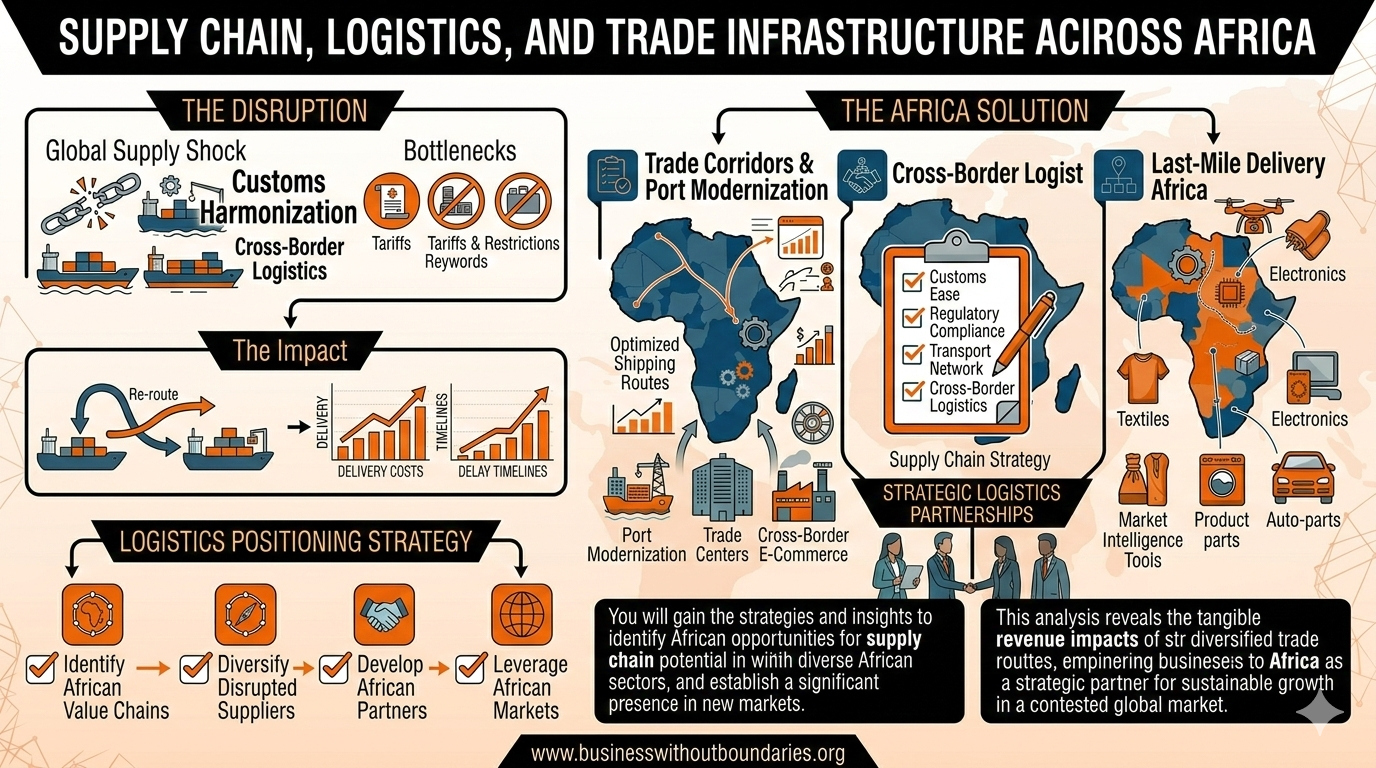
This module also addresses the green transition directly. The AfCFTA Secretariat’s 2026 priorities explicitly include green industrial projects. You will learn how to adopt circular economy principles in your operations, access climate finance, meet emerging global ESG standards, and position your products within green mineral value chains — turning raw resources into high-margin processed exports instead of low-margin raw commodities.
- Identify the most cost-efficient cross-border trade routes for your specific sector
- Build a supply chain strategy that works within Africa’s current infrastructure
- Navigate customs harmonisation changes and reduce border clearance delays
- Develop a green value-chain strategy for sustainable, high-margin exports
- Access climate finance and meet ESG standards required for future AfCFTA trade partnerships
Women, Youth and Inclusion — Your Specific Opportunities Under AfCFTA
AfCFTA was not created to be the same for everyone. It has special rules that aim to help women and young people get involved in the economy. Unfortunately, a lot of women and businesses led by young people that could benefit from these rules are not aware that they even exist or how to take advantage of them.
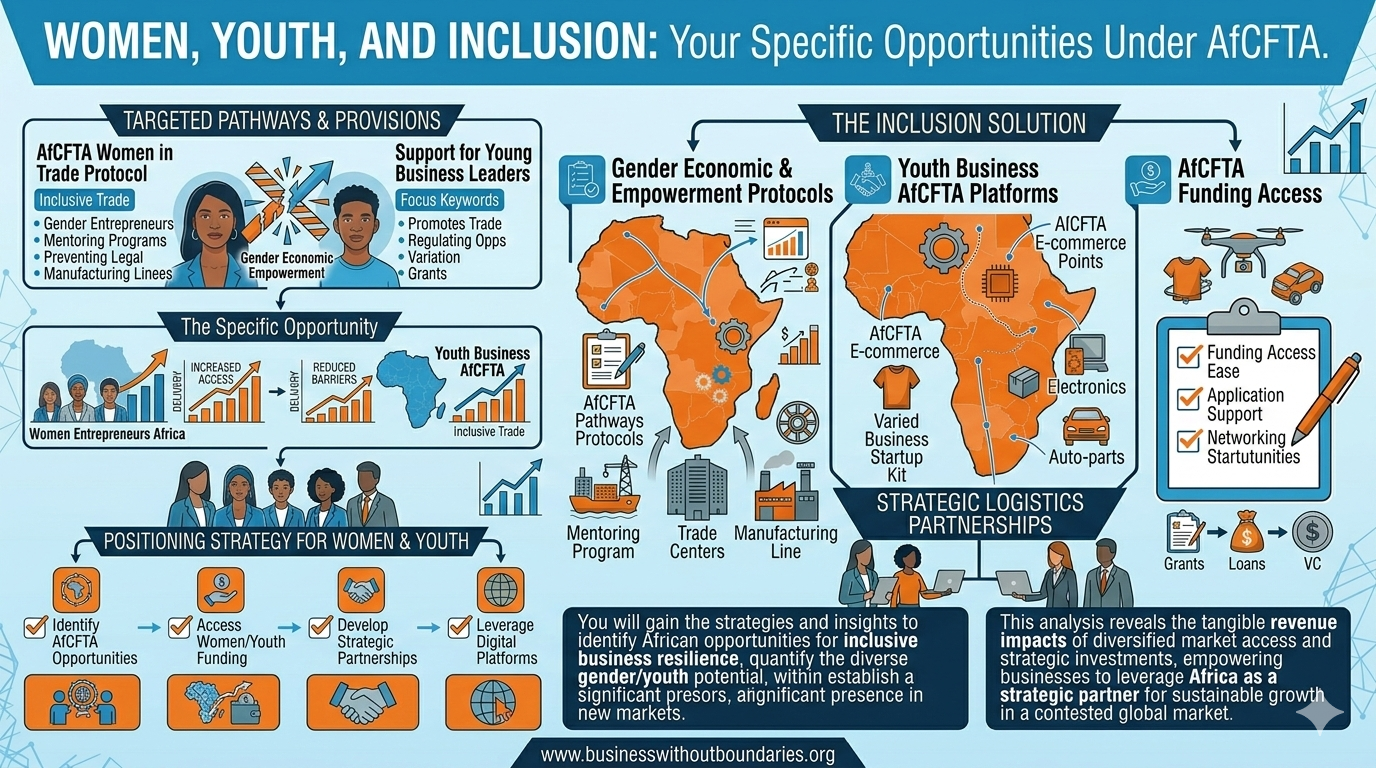
This module will change that. You will dive into the AfCFTA Women in Trade Protocol and look at it closely: what it asks from the countries that signed it, what financial help and support it provides, and how to use specific parts of the protocol when dealing with banks, finance groups, and government agencies. You will also find out which markets and industries currently have the best opportunities for businesses run by women and youth.
- Understand and apply the AfCFTA Women in Trade Protocol in real institutional conversations
- Identify the financial tools and DFI support available specifically for women and youth-led businesses
- Reference specific protocol provisions when negotiating with banks, investors, and government bodies
- Map the markets and sectors with the strongest inclusion-driven opportunity right now
- Build your Women & Youth Inclusion Action Plan as part of your 90-Day readiness roadmap
Building Your Personal AfCFTA Readiness Plan — Your 90-Day Trade Floor Plan
In this module, everything joins together. Every tool you’ve created, every market you’ve looked into, every rule about origins that you’ve learned, and every chance in different sectors that you’ve explored — it all merges into one detailed document made just for your company, your field, where you are right now, and the markets you want to reach.
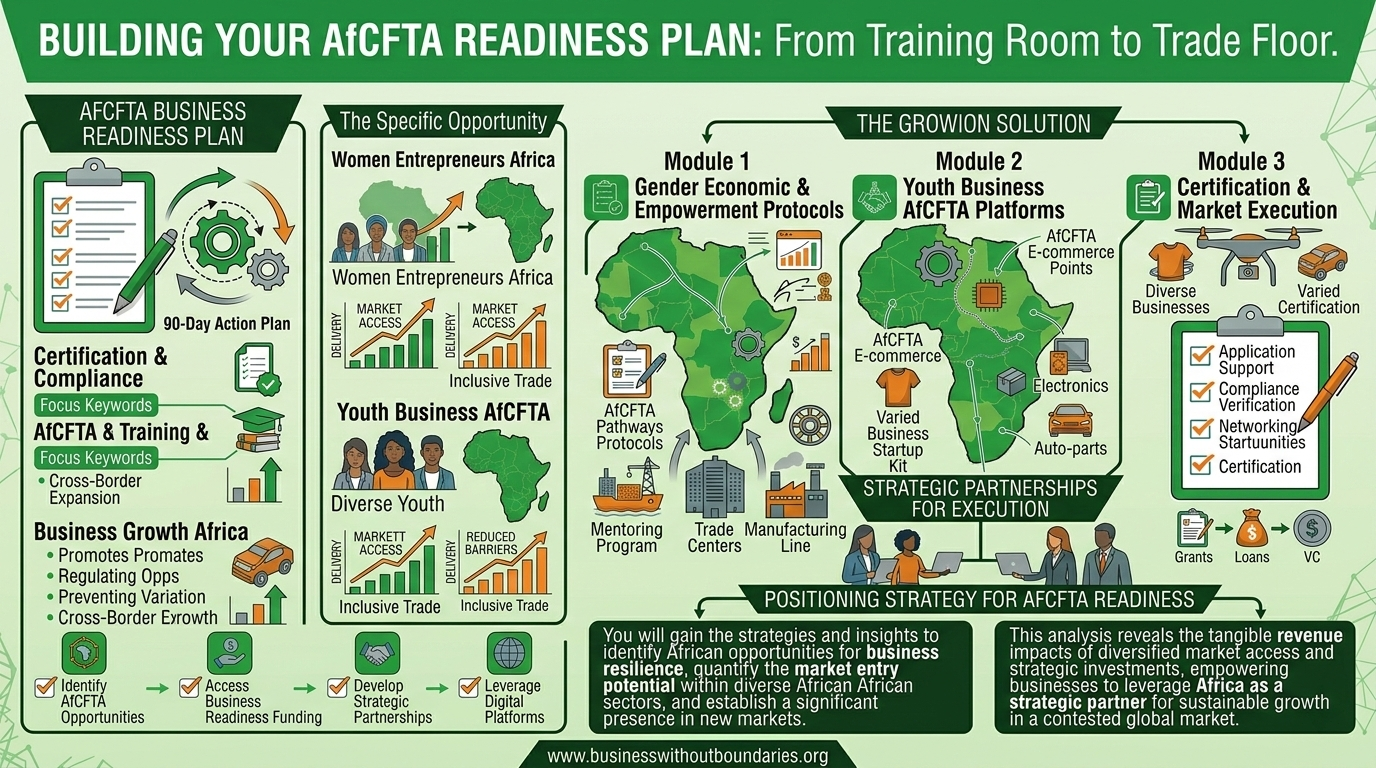
Everyone who takes part in this module will walk away with a customised AfCFTA Business Readiness Plan they can start using the next week. This isn't a basic outline. It's not an exercise in theory. It’s an actual, personalised plan that includes a clear action plan for the next 90 days, specific markets chosen, steps for compliance laid out, and different financing options explained.
- Personalised 90-Day AfCFTA Trade Floor Plan specific to your business
- 1–2 AfCFTA target pilot markets identified and evaluated
- Export compliance roadmap: documentation, certification, payment terms
- Financing access map: Afreximbank instruments, DFI options, trade finance solutions
- Investor matchmaking introductions (Executive Package participants)
🏆 Plus: The BWB AfCFTA Strategy Certified Planner Badge
Finish the entire program and turn in your assignments. You will earn the official BWB AfCFTA Strategy Certified Planner digital badge, which you can share on LinkedIn and that is acknowledged by investors, development finance institutions, and organisations that support trade all over Africa. This badge shows that you are not only knowledgeable about AfCFTA, but you are also putting it into action.
Choose Your Level. All Credits Apply Upward.
Participants can choose any programme level based on their needs and goals. All three formats cover all eight modules.Every module includes: course content with African business owner case studies, market intelligence resources, 8 workbooks with 6 structured exercises, question quiz with answer explanations, forum discussion guide, case studies, 5 essential resources, and video recommendations.
The difference is the delivery, the depth of interaction, and the pace. Choose the format that fits how you learn best. Every credit earned at any level applies toward the full certification at any time. Nothing you invest is ever wasted."
- Access to all eight modules — full progressive curriculum
- Comprehensive training materials and strategic workbooks
- Your personalised AfCFTA Business Readiness Plan
- BWB AfCFTA Business Readiness Certificate
- Membership to the BWB AfCFTA Business Network
- Post-training resource library
- One Q&A session with Lady Topsie — 30 days post-programme
Intensive: Four consecutive days, two modules on the final day.
Working Professional: Eight weeks, one module per week.
- Facilitated by Lady Topsie (or licensed senior BWB facilitator)
- Peer cohort of business leaders online
- Access to all eight modules — training materials and strategic workbooks/li>
- One module per week over 6 weeks
- BWB AfCFTA Business Readiness Certificate
- Session recordings included
- BWB post-training networking community
- One Q&A session with Lady Topsie — 30 days post-programme
- All eight modules materials, tools and workbook
- Stack modules over time at your own pace
- E-learning platform access/li>
- BWB post-training community